Selecting the right hoisting equipment often comes down to the balance between raw lifting power and the precision of the cable winding system. In heavy-duty industrial environments, a poorly managed rope arrangement can lead to premature wear or catastrophic failure, making the choice of winding technology critical for operational safety.
The global shift toward high-precision machinery has placed a renewed focus on the internal mechanical components of lifting systems, particularly how gears and drum grooves interact to handle massive loads. Whether in offshore oil platforms or urban construction, the reliability of the winding mechanism determines the lifespan of the entire system.
Understanding the technical nuances of a china electric cable winch involves analyzing the synergy between electrical power, gear transmission, and drum geometry to ensure stable performance under extreme stress.


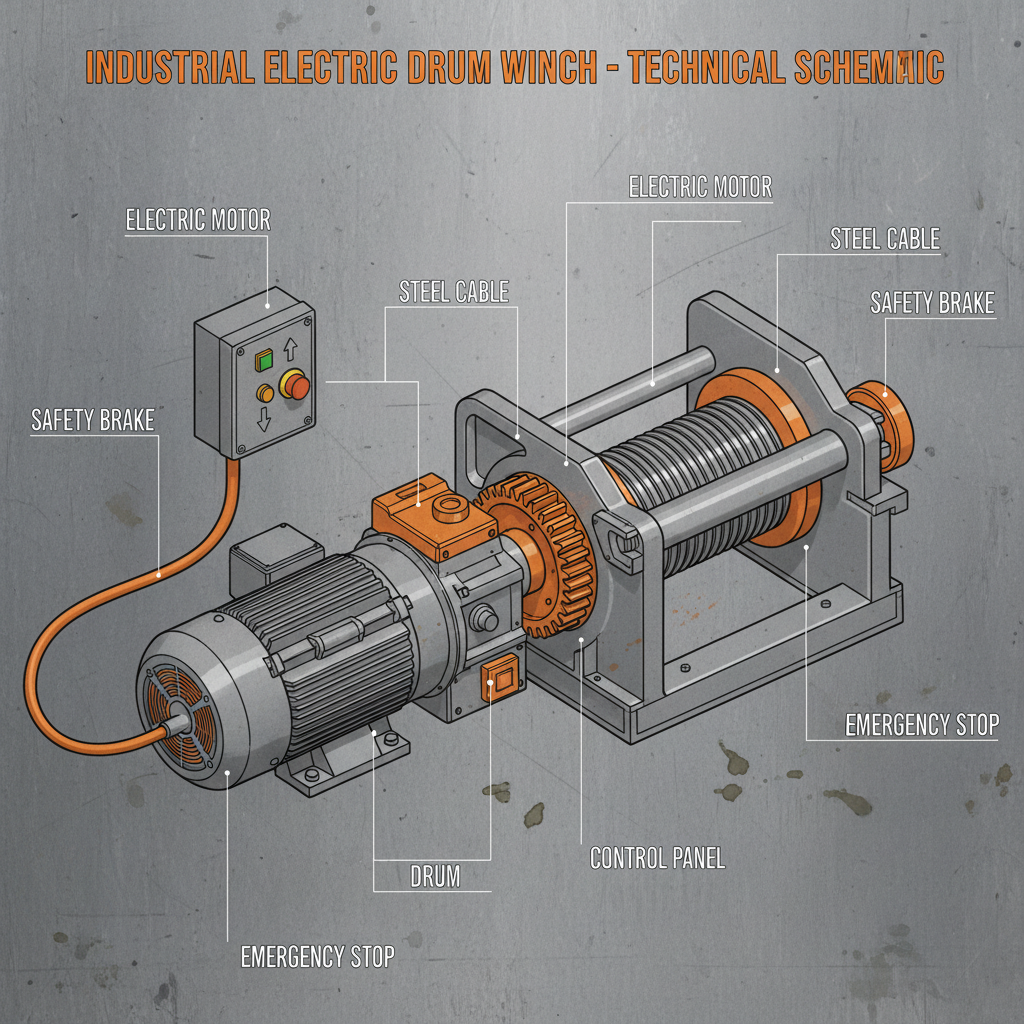
At its core, a winch system is an exercise in managing tension and friction. The transition from electrical energy to mechanical lift occurs through a series of gear reductions that convert high-speed motor rotation into high-torque drum rotation. The efficiency of this process depends heavily on the gear module and the material integrity of the teeth.
Modern winding technology has evolved to handle gear modules from 0.004mm to 100mm, allowing for a massive range of scales—from small precision motor winches to heavy-duty industrial drums exceeding 150 meters in diameter. This versatility ensures that cable retracting systems can be tailored to specific load requirements.
The choice of gear profile directly impacts the noise levels and the load capacity of the winch. Spur gears, characterized by straight teeth, are favored for their simplicity and high efficiency. They are ideal for applications where cost and manufacturing ease are priorities, provided that the resulting noise is acceptable for the operating environment.
For higher speeds and heavier loads, helical gears are implemented. By angling the teeth, the engagement happens gradually rather than all at once, which significantly reduces impact vibration. This results in smoother transmission and a higher contact ratio, which is essential for the stability of large-tonnage cranes.
In the most demanding scenarios, such as heavy machinery differentials, herringbone (double helical) gears are used. These eliminate the axial thrust associated with single helical gears by using symmetrical opposite angles, providing self-centering abilities and maximum load-bearing capacity.
Material selection for these gears is as critical as their geometry. To withstand the immense pressure of heavy lifting, manufacturers employ a variety of treated steels, including quenched and tempered steel or carburized quenched steel for enhanced surface hardness and core toughness.
The fundamental trade-off in gear design involves balancing axial force, transmission noise, and manufacturing cost; while herringbone gears offer the best performance, their complexity increases production costs significantly.
For lighter loads, ductile iron or even plastic gears are used to minimize noise and cost. However, in professional cable winches, forged steel remains the standard due to its superior fatigue strength compared to cast steel, ensuring long-term reliability in safety-critical applications.
Evaluating the effectiveness of a winch system requires looking at several qualitative and quantitative indices. Load-bearing capacity, rotational speed, and transmission efficiency are the primary metrics. For instance, the circumferential speed of modern gears can reach 300 meters per second, enabling rapid deployment in specific industrial contexts.
When assessing different gear types, we can look at their relative suitability based on operational priorities like noise reduction versus cost efficiency. The following index illustrates the relative strengths of common gear configurations used in winding systems.
Industrial winches are frequently deployed in corrosive or high-stress settings. Offshore platform cranes and oil workover drilling winches, for example, require not only high torque but also exceptional resistance to environmental degradation. In these cases, the integration of grooved sleeves and alloy steel drums becomes essential to prevent cable slippage and uneven winding.
Other specialized applications include logging rope winding equipment and helicopter motor winches. Each scenario demands a specific configuration—some prioritizing compact size and lightweight design, while others prioritize absolute stability and massive tonnage capacity, such as those used in mining or heavy construction.
The future of winch technology is moving toward a "heavy-duty yet high-precision" paradigm. There is an increasing effort to study the tooth damage mechanism of gears to establish more reliable strength calculation methods, thereby extending the service life of the equipment.
Research into elastic deformation and temperature field distribution is now being used to improve the contact area of gears under full load. This prevents localized wear and ensures that the winch maintains its efficiency even during prolonged periods of operation.
Furthermore, the industry is seeing a shift toward integrated technical support, where maintenance, repair, and customization are handled as a single lifecycle service to ensure that high-precision drums and gearboxes continue to run effectively.
When selecting a cable winch, the primary decision matrix should revolve around the load type, duty cycle, and environmental constraints. A manufacturer evaluating a system for a scientific research ship will have vastly different requirements than one designing a wall-wiping machine winch.
One must consider the trade-offs between different drum types—such as smooth drums versus double-fold rope groove drums. While smooth drums are simpler, grooved drums provide the essential stability required for large tonnage crane operations, preventing the cable from crushing itself under tension.
The following table provides a comparative framework for evaluating different gear and drum configurations based on common industrial needs.
| Configuration | Primary Advantage | Key Limitation | Best Application |
|---|---|---|---|
| Spur Gear / Smooth Drum | Low Cost, High Efficiency | Higher Noise, Cable Overlap | Light Industrial Lifting |
| Helical Gear / Grooved Drum | Smoothness, High Capacity | Axial Thrust on Shaft | Automotive / Factory Automation |
| Herringbone / Alloy Drum | Max Load, Zero Axial Force | High Mfg. Complexity | Heavy Machinery / Differentials |
| Forged Steel / Grooved Sleeve | Extreme Fatigue Strength | Higher Material Cost | Offshore / Oil Drilling |
| Cast Steel / Smooth Drum | Cost-Effective for Large Scale | Lower Strength than Forged | General Construction |
| Plastic Gear / Light Drum | Silent Operation | Low Load Bearing | Consumer Goods / Small Winches |
Spur gears have straight teeth and engage simultaneously across the tooth width, making them efficient but noisy. Helical gears have teeth cut at an angle, allowing for gradual engagement. This results in smoother operation, higher load capacity, and significantly reduced noise, which is critical for high-speed industrial winding systems.
A grooved drum should be selected for any application requiring high precision or heavy loads. Grooves ensure that the cable winds in a neat, layered fashion, preventing the rope from overlapping or crushing itself. Smooth drums are acceptable for light loads or short cable lengths where precision winding is not a safety requirement.
Materials like forged steel, especially when quenched and tempered, offer far superior fatigue resistance compared to cast iron or cast steel. Using high-grade alloy steels for the drum and gear teeth reduces wear and prevents deformation under full load, which directly extends the maintenance intervals and overall service life of the winch.
Herringbone gears are double helical gears that cancel out the axial thrust produced by a single helical gear. This eliminates the need for complex thrust bearings and provides a self-centering effect, making them ideal for the highest load-bearing requirements in heavy industrial gearboxes and winches.
Yes, provided they are engineered for such conditions. Offshore winches require specialized corrosion-resistant coatings, sealed gearboxes, and high-strength materials like alloy steel drums. The focus is on preventing saltwater intrusion and ensuring the mechanical components can handle the dynamic loads of sea-based cranes.
The most effective way to reduce noise is to replace spur gears with helical or herringbone gears. Additionally, ensuring proper lubrication and using precision-ground gears reduces vibration. In light-load scenarios, incorporating plastic or composite gears can further dampen acoustic output.
The efficiency of a china electric cable winch is not defined by a single component, but by the integration of gear geometry, material science, and drum design. By matching the gear type—whether spur, helical, or herringbone—to the specific load and noise requirements of the application, operators can significantly increase both safety and productivity.
As the industry pushes toward higher precision and longer lifespans, the focus on tooth damage mechanisms and elastic deformation will continue to refine how we build these essential lifting tools. Investing in high-quality forged components and precision-grooved drums remains the most reliable path to operational excellence in heavy industry.